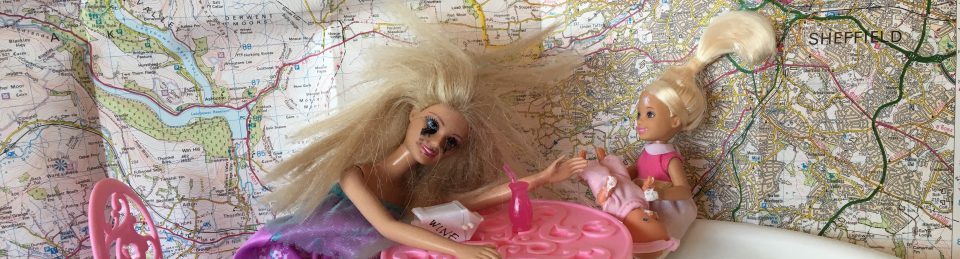
“Ahhhhh, Congratulations! Girl or a boy? How much does she weigh?”
These are the questions that typically follow the magical creation of life.
They are the wrong questions.
Because sometimes, a bundle of joy comes out as a bundle of fear.
The questions we should really be asking new mothers include: “How are you? Did you get enough support? Do you want to tell me about it? What do you need?” And possibly, if you know them well enough, “Has anyone talked to you about pelvic physiotherapy?”
I often tell the Big Small that she’s the best thing that ever happened to me. This is because it’s true, and also because everyone deserves to hear that from someone. (Now I get to smile when I hear her say the same thing to Catonthenetheredge). 🙂
But the best thing happened in the worst way.
Her birth was not what I imagined, to say the least. And for me, postnatal depression began in the labour room.
I thought I was prepared by my rather airy fairy NCT classes to power through the pain and be empowered by it. I thought I’d read-up and watched-up on it. I genuinely believed in the birth plan (I was so cute!) and I genuinely thought I’d tough it out with a tens machine and a bit of a massage…
Ha ha ha ha!!!!!
Instead my birth story was a tale of mistakes and over-stretched midwives, shift changes, and ultimately long, long hours of a back-to-back labour stuck on my back with a monitor on, and no pain relief. The epidural had failed, but no one noticed and I was treated like I was making a terrible fuss over nothing. All followed by an emergency c-section.
BIG FUN.
That particular combination of impotence and injustice is pretty huge to deal with, and is something I still grapple with today. It somehow takes you right back to being a child, doesn’t it? The powerlessness, rage and fear of it – nameless and hopeless swelling in your chest. The knowledge no one believes you and no one will help you.
That sudden understanding that when it really, really comes down to the wire – you are fundamentally alone.
The loneliness of motherhood started there. Right there. And thinking back I can still taste the blood and metal of it – that very moment – under my tongue.
Not being able to control your own body or your fate is pretty scary for anyone. Not being able to do what millions of women have done throughout time is pretty disappointing, too. And it all came with a sense of distance, and inadequacy, and isolation, and desperation like I’ve never known.
None of that actually left my body with the placenta. It didn’t just disappear – how could it? It all stayed inside. And it made the bits that came next even harder.
It was all still there as I struggled to adjust to motherhood, to feed the baby (intent on starving itself – another story), to manage, to love every moment, to join in, to be joyful – to feel myself, to feel REAL again. I was overwhelmed by it. I thought I had made a huge mistake. That I couldn’t do this. That I’d let the baby down and didn’t deserve her.
Now, I’m one of the lucky ones, because in the midst of all that I was still violently in love with her. That doesn’t always happen.
And no bloody wonder.
Even the births that go right are huge physical events that change your body forever, followed by huge responsibility, no sleep, and massive hormonal fluctuations. And there is so little support. Your partner goes back to work after two weeks, and you are left broken in a fog, in charge of a tiny person you have no idea how to care for, with endlessly conflicting advice and everything you’ve ever known fundamentally altered.
And yet it is so universal…
So how can it be that we are still sending women into the breach (sometimes literally) so woefully under-prepared and under-supported?
And how can it be that we still don’t talk about postnatal depression, or birth trauma, or the horrors of early motherhood?
How are we still not asking women the right questions?
There has to be a line somewhere between scaring expectant mothers stupid, and giving them the coping mechanisms, tools and knowledge to help them take control of their bodies, and their babies, and make informed choices – even when things start to go wrong.
I don’t think we’ve got the balance right.
Today is Father’s day, and fathers are to be celebrated. But the day fathers became fathers was the same day that mothers became mothers (pretty obviously), and there’s no point pretending it wasn’t a day that had a far bigger impact on HER life than on his. It’s a combination of biology and society.
The real question is how we make that impact more positive.
If you had a traumatic birth, there’s a great organisation that’s there to help – The Birth Trauma Association. They do fab work to support women (and men) after traumatic birth experiences.
And if you’ve got an experience you’d like (or need) to share, I’d like to hear it.
 Mumonthenetheredge