
The most popular post I’ve ever written on this blog was about the #metoo movement.
It turns out people really, really want to talk about low level sexual discrimination, harassment and assault. In fact if you read the comments on the post, it’s very clear how quickly and smoothly those turn into medium level, and then extreme examples.
I cried reading about some of those experiences.
And as I cried, I realised that crying was kind of one of them… a subtle, everyday way women are undercut.
The last few months have been emotional ones for me, in many different ways. And while in theory I know having an emotional reaction to an emotive situation is both rational and consistent – there is a large part of me that believes it is not.
Because I have been conditioned to think that my emotions are untrue, disproportionate, and inconvenient.
I have stopped trusting them. And I have stopped trusting myself. Because if you can’t believe what you’re feeling, what can you believe? You have no foundations to stand on.
But slowly, as I pick myself up, I am beginning to realise that there is an innate sexism attached to emotions, and how they are perceived in society.
If a grown man loses his cool (without resorting to violence, obviously) he is being assertive, sticking to his line, drawing one in the sand, sending a clear message – not being a pushover. He is strong.
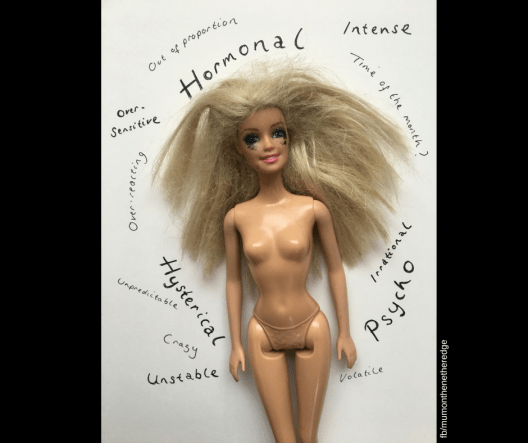
If a grown woman does the same she is being hysterical, volatile, erratic, she is over-sensitive and over-emotional. She is easily dismissed. She is weak; and she is wrong.
I imagine a lot of women out there could say, ‘me too’ to this. Because the refrains used to undermine the validity of our emotions are so familiar, and so ingrained. And the most frustrating thing of all is that if we rail against them, we are doomed to PROVE them in the most frustrating of catch 22s.
How many do you recognise?
“You’re overreacting.”
“You’re misinterpreting what I’m saying.”
“Is it that time of the month?”
“You need to bring it down a notch.”
“You’re being really intense.”
“You’re too sensitive.”
“What are you crying for?”
“Psycho.”
“I can’t deal with you when you’re like this. “
“You need to calm down.”
“You’re blowing this out of proportion.”
Our emotions are unreliable.
And we are told so in no uncertain terms from a very young age.
Robert Webb has written of the damage caused to boys by being told not to emote. But there is similar damage caused to girls too, by being told they OVER emote.
Hysteria is the term historically used to dismiss female emotion – their wombs making them less. Less rational, less reasonable, less able to cope. Less everything.
The fact is that as women, to gain respect we are expected to make things easy for everyone – not to make a fuss. It is part and parcel of the same insidious secrecy and silence that is unravelling in the public eye in #metoo and #timesup.
Because our reaction to a situation – no matter what the provocation, mistreatment or injustice – is STILL always somehow greater than the original crime.
It is the woman scratching her keys down her husband’s car who is more frowned upon – the psycho – than the man having the affair.
It is the woman speaking out against assault – and daring to do so with emotion – who is unstable, and untrustworthy. Not the man she is accusing – not unless many hundreds more join her chorus.
The only recourse deemed suitable by society in these situations seems to be silent dignity. Because showing anything else makes women more guilty and more wrong.
But silent dignity is still silenced.
It still denies us a voice.
I have undoubtedly been more emotional since I had children. And I have assumed – and been told – it is a weakness.
What if that’s a lie though?
What if we’ve ALL been lied to?
What if emotion is a strength?
Emotional intelligence is not about NOT showing emotion or pretending not to feel it. It’s not about sucking it up, bottling it up, or denying it.
We certainly should not be at the mercy of our feelings. Not everything you feel should be immediately acted upon – that’s the ultimate key to emotional intelligence.
But it IS about feeling your feelings, recognising them, accepting them, appreciating the purity and truth of those instincts. Letting them pass through you and coming out the other side.
Because by going through them authentically, you will be a truer you, and you will make BETTER decisions.
And maybe that skill – because it is a skill – makes you a better person, a better employee, a better spouse, a better friend, and most certainly a better parent.
Because how will our children ever learn to process their emotions, connect with them, recognise them in others, and ultimately trust themselves, if we don’t show them how to do so?
My feelings, my empathy, my heart, my tears, my sense of justice, my poetry, my LOVE – they are the best bits of me. Not the worst.
And I will no longer be afraid of them.
 Mumonthenetheredge