Every New Year, when I sing Auld Lang Syne (now at 9pm – AKA Kid Midnight), I wonder what the hell it means. And then I wonder if I’m wondering that because Billy Crystal wonders it at the end of ‘When Harry Met Sally’, one of my favourite films in the world ever. And then I wonder when I last watched it and if it’s on Netflix. And then I forget all about Auld Lang Syne altogether.
But this year, for the first year, I think I finally get it.
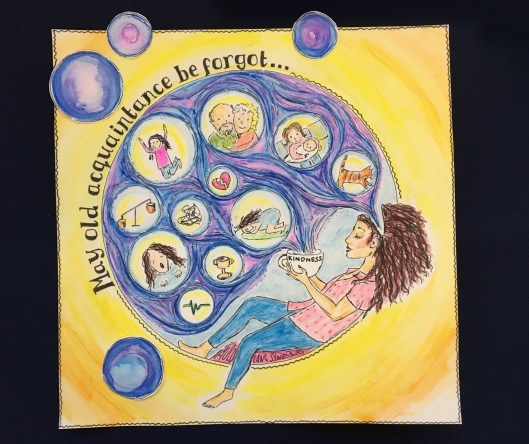
Because it’s a song about forgetting. About forgetting as a blessing. About forgetting as a kindness – a cup to drink from well and often.
Because it is.
Amnesia is basically central to the human condition – and I’ve come to believe it’s what makes us so successful as a species. We can feel and then forget, and then remember and reflect anew – in a way other animals simply can’t. We process our lives and our experiences differently.
For instance, if we didn’t forget, the vast majority of women would definitely only ever have one child. But the horror of ripping and stitches and blood and pain recedes surprisingly quickly – and many of us are ready to go through it all over again in just a few short months or years.
If we didn’t forget, no one would ever survive a loss. But even though we don’t want it to – even though we feel guilty when we notice – normality creeps insidiously back in. We learn, in time, to breathe in and out again without having to think about it. We hear the birds again. We smile at jokes. We come out of the other side, eventually, perhaps just a little bit different.
We are also able to forget not just experiences and feelings, but even the bits of ourselves we like the least. We are all able to conveniently edit our narratives so we remain the hero of our own stories. So we can carry on.
We forget, in time, our greatest joys, our deepest griefs, and our most shameful moments. Because no one can hold onto that intensity of emotion for too long – it’s just not how people work. You literally can’t live there. You will be gripped by fear or sorrow or anger or desire or mortification or sheer despair so fiercely it bulges your eyeballs – and just a few minutes later it will recede back to manageable levels – at least for a while.
It’s how we’re built.
It’s how we survive.
And it’s a very strong instinct.
When we are teaching our Small People to recognise, name and pass through their very big feelings, we are really teaching them to forget. We are teaching them that those intense moments will pass. We are teaching them how to survive their own internal storms – even if we still battle our own.
The other day, for instance, I wrote a poem about missing my kids when they’re at their Dad’s house. And someone told me I was acting like they’d died, and that basically I needed to get a grip.
They were kind of right.
I was. And I should.
I deleted the post. But it was a description of a moment – a painful spike – that then dropped back down to normal – my new normal at any rate. And it was a pain not just about the now, but about missing them in the future too – all the holidays, and days out, and family times we won’t have, and all the conversations, cute moments and milestones I won’t be there for.
It was all of those things at once, in one moment…
… and then the moment passed. I could breathe again.
And it passed partly because I grabbed hold of it, dug my claws in, thrashed it around, pulled it apart and thoroughly dissected and understood it. I felt it to the nth degree. I then posted the resulting poem because I thought it was a moment that other people going through the same thing might identify with. And afterwards I had a good cry, re-read an old and soothing Georgette Heyer book –
and forgot.
Mostly.
Writing is basically my way of forgetting. Because if I really wallow, style and lose myself in one of those moments, I purge it. And once it’s out, it’s almost always easier to deal with. Sometimes it comes back, but certainly it is better. And I can re-read it and remember that moment – but it won’t own me anymore. I own it.
(Occasionally this may make my writing a bit repetitive – for which I apologise – but I quite literally cannot always remember what I’ve written).
But here’s the thing: If your natural human capacity for amnesia is missing, or broken, or itself forgotten – YOU ARE IN SOME VERY SERIOUS TROUBLE.
Because if you can’t forget something – at least temporarily – you will almost certainly go mad with it.
Whenever I have struggled most with my mental health, I think it is my ability to forget that’s really what has gone haywire. It is when the balance has tipped – and I either remember too much in too much horrific detail, or forget too much, and am unable to hold onto a single thought or truth.
In fact, the inability to forget in the right, healthy ratios is probably part and parcel of pretty much every experience of mental illness. It is the core of bitterness, of depression, of obsession, addiction, anxiety, grief, PTSD, insomnia – and so much more.
Right now, alongside that sadness in my poem, I’m battling to forget my anger. The sheer rage I feel at my lost family, my betrayed love, my absent kids. When I am blinded by it, the only thing I can really do is to remember that it will pass. And hold onto that until it finally does. And then I breathe. And then I write it out.
And then I anaesthetise what’s left it with 18th Century romances, Meg Ryan classics, or a bath.
And then when it creeps back in I do it all over again.
Forgetting doesn’t just make the world go round; it isn’t just a skill to be learned; it’s a GIFT. And we should be grateful for it.
But it is not without pain.
Sometimes forgetting hurts.
It hurts to look at pictures of our babies as babies, but not to be able to remember them being that small. It was so all consuming and all encompassing – but gone with the wind.
It hurts to realise that even though you have pictures of a loved one who died, one day you can’t quite remember their face in your own head – you’re remembering the picture. And that memory slipped away without you even noticing.
In those moments of sadness, it is worth thinking about the true opposite of forgetting. Not just forgetting interrupted; but forgetting reversed.
A very long time ago I worked in the kitchens of an old people’s home as a holiday job. I was basically responsible for mushing up the food and taking it upstairs to what was then called an EMI unit (people with dementia). And the woman in charge of the kitchen once said to me that the real tragedy wasn’t in what people forgot, BUT IN WHAT THEY REMEMBERED.
At the time it made even less sense to me than Auld Lang Syne, because I was young and pretty stupid. But now I get that too.
It is unbelievably painful to see someone you love forget so much – sometimes forget you. But it must also be so very, very painful to relive old memories and old feelings – to be back in those moments of rapture or rage or despair, to feel all of those things brightly and profoundly like they’re happening right now – and then find yourself suddenly, disorientingly plunged back into a time, place and a body that make absolutely no sense to you.
It is a cruelty that is almost too awful to think about.
And it makes me glad and grateful for forgetting. And it makes me determined to forget a little more. To practice it – and to keep teaching it to my children.
So this new year, I wish amnesia for you. Just the right amount – just enough to get you through.
I hope you find your own way to forget, what and when you need to.
I hope that you forget old acquaintances, old mistakes, and old hurts.
I hope you forget for old times sake, for your own sake, and for your own sanity.
I hope you drink from that cup of kindness that is the power and beauty of forgetting.
Because the more you forget, the more space you will have in your heart for forgiveness, and in your brain for new and wonderful memories.
Happy New Year.
Mumonthenetheredge
xx
 Mumonthenetheredge
Omg this post was so well written. I actively practice forgetfulness, as I just can’t cope with every little thing. But the things that hurt… ahhh how they do! It was perfect. One of those things a lot of people must feel, but probably not articulate or acknowledge. Thank you!! Ps. I used to live in Nether Edge!
LikeLike
Sorry it’s taken so long for me to respond to this. Not having the best of times… Thank you for reading, and thanks for responding. Thank you also for understanding – I wasn’t sure I’d quite articulated it quite right! Nether Edge is still lovely, by the way. xxxx
LikeLike